
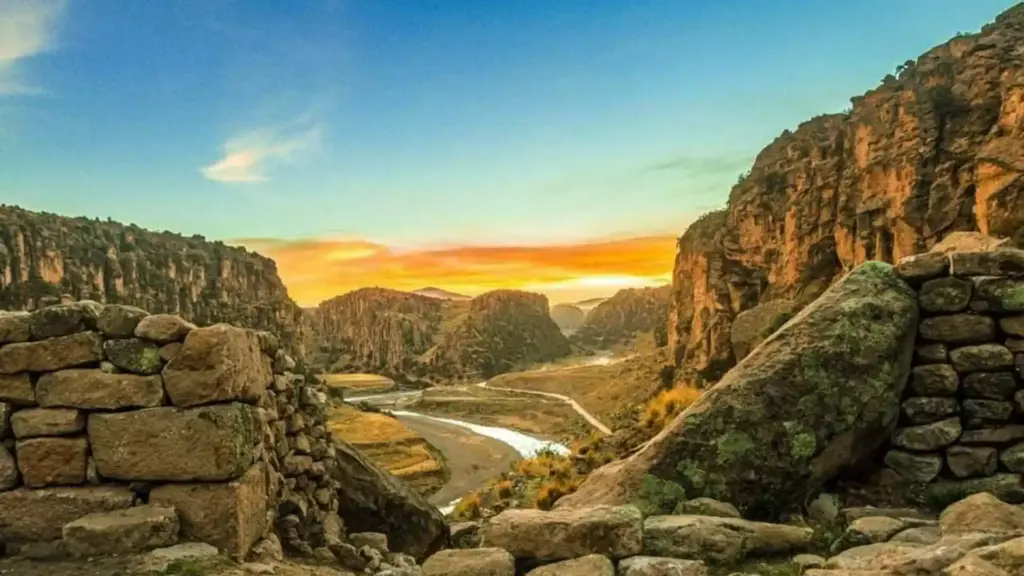
There is another Cusco beyond Machu Picchu.
Far south of the Sacred Valley, beyond the routes most travelers ever see, the landscape becomes broader, higher and emptier. Roads cross puna grasslands. Villages grow smaller. The Apurímac cuts deeply through volcanic rock.
And at more than 4,100 metres above sea level, on a wind-scoured plateau in Espinar, rises one of the most intriguing archaeological sites in Peru.
T’aqrachullo.
In 2026, National Geographic brought international attention to the site with a major investigation asking whether these extensive ruins could be the long-lost Inca stronghold of Ancocagua, a place remembered in colonial chronicles as a sacred sanctuary and the setting of one of the most dramatic episodes of resistance during the Spanish conquest.
The headline was irresistible: a forgotten Inca citadel, roughly four times the extent of Machu Picchu, hidden in the southern Andes.
The reality is even more interesting.
Because T’aqrachullo is not simply an Inca ruin waiting to be rediscovered.
It is a place where more than a thousand years of Andean history appear layered one above another.
And that is precisely why it matters.
T’aqrachullo was never really “lost”
The language of lost cities is seductive.
But it can also simplify history.
Local people knew T’aqrachullo. Archaeologists had been working there long before National Geographic arrived. Alicia Quirita and Maritza Candia were among the first scholars to survey the site systematically in the 1990s, when much of the plateau was still used for grazing and agriculture.
Since then, investigations by the Dirección Desconcentrada de Cultura del Cusco have gradually revealed the scale and complexity of the settlement.
The Ministry of Culture’s major publication, María Fortaleza T’aqrachullo: Investigación, restauración y puesta en valor, brings together years of archaeological, architectural and conservation work, covering everything from ceremonial buildings and pottery to archaeobotany, burials, warfare and ritual objects.
So what happened in 2026 was not the discovery of an unknown ruin.
It was something subtler.
The world finally began paying attention.
A city above the Apurímac
The setting alone explains why T’aqrachullo feels extraordinary.
The site stands on a rocky plateau in Suyckutambo, in the province of Espinar, close to the confluence of the Totorani and Apurímac rivers and above 4,100 metres in elevation.
Its core archaeological zone covers roughly nine hectares, while the wider complex extends considerably farther. Researchers have documented more than 500 structures divided into five principal sectors.
There are rectangular buildings associated with the Inca period.
Circular and semicircular structures connected with earlier local occupations.
Buildings shaped like the letter D, a form often associated with Wari ceremonial architecture.
There are also kallankas, funerary chullpas, paved paths, ceremonial stairways and ritual water features known as phaqchas.
That variety immediately tells archaeologists something important.
T’aqrachullo was not built once.
It was occupied, transformed and reinterpreted repeatedly.
More than a thousand years of occupation
The archaeological sequence stretches across three major periods of Andean history.
Evidence places occupation in the Middle Horizon, roughly 700–1000 CE, followed by the Late Intermediate Period, approximately 1000–1476, and finally the Late Horizon under Inca rule, around 1476–1532.
That means T’aqrachullo preserves traces of societies that lived here centuries before the Inca incorporated the region.
The Wari connection is especially intriguing.
Architectural forms and ceramic evidence suggest the site was already important during the Middle Horizon, when the Wari state was extending influence through large parts of the Andes.
Later, the region became associated with the Canas and other highland societies before eventually entering the Inca political world.
The result is not a straightforward “Inca city.”
It is a palimpsest.
One civilization built.
Another adapted.
Another imposed new political and ritual meanings.
And the landscape remained important through all of them.
Was T’aqrachullo really Ancocagua?
This is the question that has brought the site back into international attention.
Colonial chroniclers described a powerful sanctuary known as Ancocagua.
Pedro Cieza de León referred to an ancient and highly revered temple in this southern region. Juan de Betanzos described a fortified location associated with rebellion during the early years of Spanish rule.
For centuries, nobody could confidently place it on a modern map.
Then archaeologist and National Geographic Explorer Johan Reinhard began comparing the colonial descriptions with the actual geography of southern Cusco.
After visiting T’aqrachullo in the 1990s, Reinhard argued that the site matched Ancocagua remarkably well. He published that hypothesis in Andean Past in 1998.
The case is circumstantial, but compelling.
The plateau is naturally defensible.
The Apurímac canyon creates steep barriers around it.
Access can be tightly controlled.
And archaeological evidence suggests both ceremonial importance and military activity.
Recent excavations have uncovered stone projectiles, obsidian spear points and human remains showing signs of violent injury. Researchers also found evidence that access routes may once have been deliberately blocked.
These details echo the colonial descriptions of a siege.
But archaeology has not yet produced an inscription saying: “This is Ancocagua.”
So the responsible conclusion is:
T’aqrachullo may be Ancocagua. The evidence is increasingly persuasive, but the identification remains a scholarly hypothesis.
That distinction matters.
The battle remembered in the chronicles
If the identification is correct, T’aqrachullo witnessed one of the most dramatic confrontations of the conquest.
Betanzos described a rebellion at Ancocagua after Spanish forces had begun consolidating control over the Inca state.
A Spanish force was sent to suppress the resistance.
The defenders controlled the narrow approach to the fortified plateau, making a direct assault extremely difficult. The Spanish therefore resorted to siege tactics, attempting to cut off food and water.
According to the chronicle, when the fortress was finally breached, some defenders chose to leap from the cliffs rather than surrender.
It is a powerful story.
But colonial chronicles must always be read carefully.
They were written from particular political and cultural perspectives, sometimes years after the events they describe.
That is why archaeology is so important here.
The landscape, weapons and evidence of trauma cannot independently prove every detail of Betanzos’s account.
But they allow historians to test where written memory and material evidence begin to converge.
At T’aqrachullo, that convergence is becoming difficult to ignore.
A sacred place before the Inca
There is another reason Ancocagua matters.
Cieza de León described its temple as already ancient and deeply revered in the sixteenth century.
If T’aqrachullo is indeed that sanctuary, the implication is significant.
The Inca may not have created the sacredness of this place.
They may have inherited it.
That would fit the archaeological record.
Wari-style D-shaped buildings indicate ceremonial activity centuries before Inca expansion. Later rulers may have absorbed an already powerful local sanctuary into their own religious and administrative system.
This pattern occurred elsewhere in the Andes.
The Inca were extraordinarily effective at incorporating older sacred landscapes, reshaping their meaning without necessarily erasing what came before.
T’aqrachullo may offer another example of that process.
A sacred place becoming Wari.
Then local.
Then Inca.
And eventually a battlefield.
The dead are part of the story too
One of the most striking recent studies concerns the funerary landscape.
A 2026 archaeological thesis from the Universidad Nacional de San Antonio Abad del Cusco recorded 101 funerary structures across five sectors of T’aqrachullo.
Researchers classified them into several types, including pits, cists, chullpas, rectangular structures and burials incorporated directly into rocky formations.
Their location was not random.
The study emphasizes the relationship between funerary architecture, landscape and space.
That matters because Andean settlements were never simply collections of houses and temples.
The living, the dead, mountains, water and political authority could all occupy the same symbolic geography.
At T’aqrachullo, the cemetery is part of the city.
And the city is part of the mountain.
Why T’aqrachullo feels so different from Machu Picchu
Comparisons with Machu Picchu have inevitably dominated headlines.
National Geographic noted that the wider ruins extend across approximately 43 acres, making the overall archaeological area roughly four times larger than Machu Picchu.
But size is actually one of the least interesting comparisons.
Machu Picchu and T’aqrachullo belong to completely different travel experiences.
Machu Picchu has trains, buses, timed entrances and one of the most developed tourism infrastructures in South America.
T’aqrachullo sits in Espinar at more than 4,100 metres, surrounded by high-altitude grassland, canyon systems and very little mass tourism.
The appeal is not that it is “another Machu Picchu.”
It is that it is nothing like visiting Machu Picchu today.
There are no crowds moving through carefully managed circuits.
The archaeological story is still evolving.
The surrounding landscape remains central to the experience.
And reaching the site requires intention.
For the right traveler, those are not disadvantages.
They are precisely the reason to go.
T’aqrachullo and Peru’s remote south
This is where the site becomes especially important to us at View Signature Travels.
We have been developing private journeys into the remote southern Andes, connecting Cusco with landscapes and archaeological sites that sit far beyond the conventional Sacred Valley circuit.
T’aqrachullo forms naturally within that geography.
From Cusco, a deeper expedition can move toward Pallay Punchu, the high plateau of Espinar, the Three Canyons of Suyckutambo, T’aqrachullo, Tinajani and the extraordinary geological landscapes farther south.
This is not a route designed around collecting attractions.
It is a journey through a different Peru.
One of immense skies, empty roads, high-altitude communities, volcanic formations and archaeological sites that still feel embedded in the landscape rather than separated from it.
That is increasingly what experienced travelers are looking for.
Not simply something “new.”
Something that still feels unprocessed.
What luxury means this far from the conventional route
Remote travel changes the meaning of luxury.
There may not be a five-star hotel beside T’aqrachullo.
Nor should there be.
In places like Espinar, luxury comes from the quality of the expedition around the landscape.
A private vehicle capable of handling the route.
A guide who understands archaeology, altitude and local context.
A carefully chosen camp or private accommodation.
A chef working with the logistics of remote travel.
Warmth, comfort, privacy and proper recovery after long days at elevation.
And, above all, enough time.
At View, we design these remote journeys from one-day explorations to two- and three-day private expeditions, with increasingly elevated levels of camp, culinary and hospitality support.
At the highest level, the experience can incorporate private mobile camps, sophisticated dining, wellness and highly personalized field service.
But the goal is never to make the Andes look like a hotel.
The purpose of luxury here is to make remoteness possible without erasing what makes it extraordinary.
The Three Canyons landscape
T’aqrachullo also belongs to a larger natural setting that deserves its own attention.
The archaeological site lies close to the Three Canyons Regional Conservation Area, established to protect nearly 40,000 hectares of high-Andean terrain.
Here, the Callumani, Apurímac and Cerritambo rivers have cut through enormous volcanic formations, creating cliffs and canyon walls that can rise dramatically from the surrounding plateau.
The combination of archaeology and geology is unusual.
T’aqrachullo does not sit isolated from the landscape.
Its defensive advantages, ceremonial setting and access routes are understandable only when seen in relation to the plateau and canyon around it.
This is another reason a rushed visit misses the point.
The site makes more sense when approached as part of a wider high-Andean expedition.
National Geographic did not discover T’aqrachullo — but it changed its visibility
There is value in being precise about this.
National Geographic’s 2026 story did not “discover” the site.
Peruvian researchers, local communities and the Ministry of Culture had known and studied T’aqrachullo for decades.
What National Geographic did was something else.
It brought the Ancocagua hypothesis to a global audience and assembled three decades of archaeology, colonial history and landscape evidence into a compelling international narrative.
That distinction is important because it gives credit where it belongs.
The recent story is not one of foreign explorers revealing an unknown Peru.
It is one of long-term Peruvian archaeological work finally receiving broader global attention.
The Ministry of Culture’s own research program documented occupations spanning more than a millennium, and its 2026 exhibition in Cusco presented material recovered between 1994 and 2024.
The story did not begin with a magazine cover.
It simply reached a new audience there.
Why go now?
Not because T’aqrachullo is the “next Machu Picchu.”
Hopefully it never becomes one.
Go because this is one of those rare moments when a major archaeological landscape is becoming better understood while still remaining outside mainstream tourism.
Go because the journey south reveals a version of Cusco most travelers never imagine exists.
Go because a wall, a funerary tower or an ancient stairway means something different when there are no crowds around it.
And go because archaeology feels fundamentally different when researchers are still debating what happened there.
T’aqrachullo is not a finished story.
That is part of its power.
Traveling to T’aqrachullo with View
For travelers interested in archaeology, remote landscapes and deep cultural context, View Signature Travels can incorporate T’aqrachullo into a private expedition through southern Cusco and the remote Andes.
The experience can be designed as a focused day journey for travelers already exploring the region, or as part of a two- or three-day expedition combining T’aqrachullo with the Three Canyons, Pallay Punchu, Tinajani and other less-visited landscapes of southern Peru.
Our approach is deliberately private.
Timing is built around the traveler rather than a group departure.
Guiding emphasizes context rather than simply pointing out structures.
And for multi-day journeys, logistics, cuisine, comfort and hospitality are designed around the realities of traveling through high-altitude, remote terrain.
This is the kind of Peru we believe deserves more attention.
Not because it is unknown.
Because it has been overlooked.
A different way to understand the Inca world
Machu Picchu teaches us something extraordinary about the Inca.
But it cannot explain an empire that stretched across much of western South America by itself.
To understand the Inca world more fully, travelers need to leave its most famous places.
They need to see frontier regions.
Older sacred sites absorbed into imperial religion.
Fortresses positioned above strategic routes.
Communities whose histories predate Cusco’s expansion.
And landscapes where Wari, local highland societies and the Inca appear one above another in the archaeological record.
T’aqrachullo offers all of that.
Whether future research ultimately confirms it as Ancocagua or complicates that interpretation, the site has already changed how archaeologists think about this part of the southern Andes.
For travelers, it offers something equally valuable:
a chance to experience history before it has been reduced to a familiar story.
Frequently Asked Questions
What is T’aqrachullo?
T’aqrachullo, also known as María Fortaleza, is a large pre-Hispanic archaeological complex in Suyckutambo, Espinar, Cusco. Archaeological evidence shows occupation spanning the Middle Horizon, Late Intermediate Period and Inca Late Horizon.
Is T’aqrachullo the lost Inca city of Ancocagua?
Possibly. Archaeologists have identified strong geographical, historical and archaeological parallels between T’aqrachullo and Ancocagua as described in colonial chronicles, but the identification remains a hypothesis rather than an absolute conclusion.
Is T’aqrachullo larger than Machu Picchu?
National Geographic reports that the wider ruins extend across roughly 43 acres, approximately four times the area of Machu Picchu. The two sites, however, differ greatly in function, chronology and archaeological context.
How high is T’aqrachullo?
The archaeological complex sits at approximately 4,100 metres / 13,450 feet above sea level in Espinar, southern Cusco.
Can travelers visit T’aqrachullo?
Yes. The site reopened for tourism following conservation and restoration work, but it remains significantly more remote and less visited than Cusco’s mainstream archaeological circuit.
Can View Signature Travels organize private trips to T’aqrachullo?
Yes. View specializes in private journeys into remote Peru and can design visits to T’aqrachullo as part of one-, two- or three-day expeditions through Espinar, the Three Canyons and the wider southern Andes.
Sources & Further Reading
National Geographic, 2026 — “Inside the search for the lost citadel of the Inca.” Alejandro Muñoz’s report brings together the Ancocagua hypothesis, early investigations by Alicia Quirita and Maritza Candia, Johan Reinhard’s work and the most recent archaeological evidence.
Dirección Desconcentrada de Cultura Cusco — María Fortaleza T’aqrachullo: Investigación, restauración y puesta en valor. This archaeological volume documents architecture, ceramics, occupation sequence, archaeobotany, funerary structures, warfare-related artifacts and conservation work at the site.
Ministerio de Cultura del Perú, 2026 — “T’aqrachullo: El tiempo superpuesto.” Official summary of the site’s more than thousand-year occupational history and archaeological investigations between 1994 and 2024.
Ccopa Olave & Gonzales Visa, UNSAAC, 2026. Archaeological study of 101 funerary structures identified across five sectors of María Fortaleza–T’aqrachullo.
Diario Oficial El Peruano, 2026. Summary of recent Ministry of Culture research, including the site’s 544 documented structures, architecture, occupation sequence and evidence of ceremonial and defensive activity.
Explore Peru Beyond the Familiar
Travel privately into the remote southern Andes, where archaeology, high-altitude landscapes and some of Peru’s least-visited cultural sites still exist far beyond the conventional route.
EXPLORE OUR REMOTE ANDES EXPEDITIONS
